
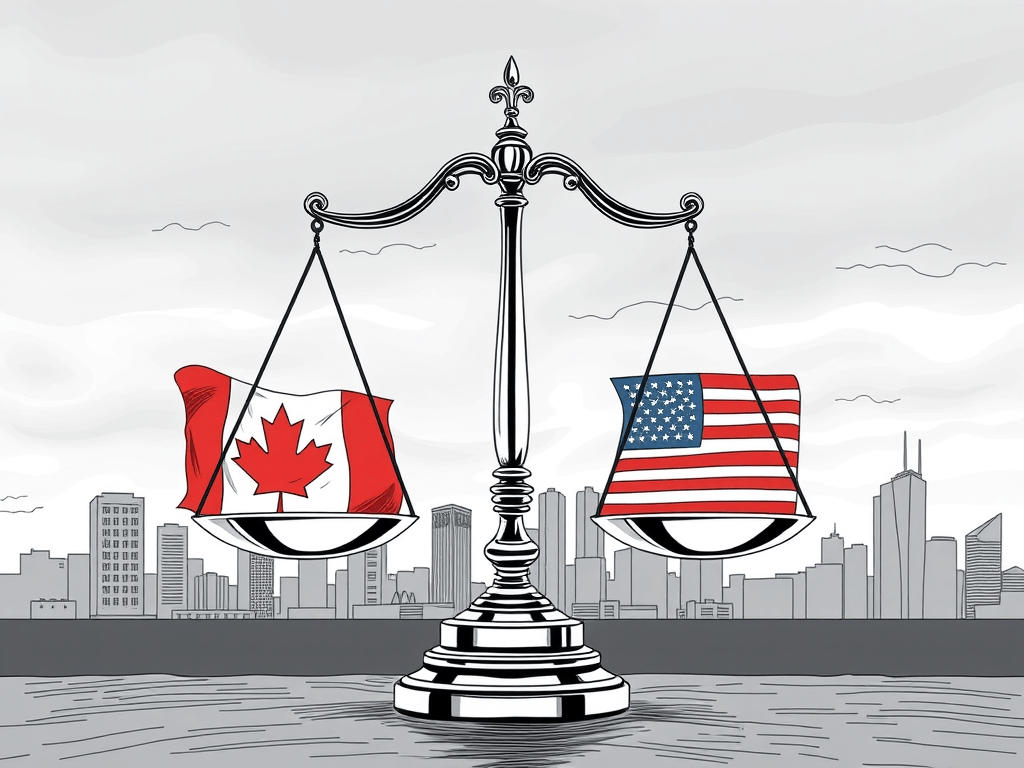
On April 16, 2025, the Bank of Canada (BoC) held its benchmark interest rate steady at 2.75%, pausing its previous cycle of cuts amid renewed global economic uncertainty. The decision came in the wake of escalating trade tensions instigated by U.S. President Donald Trump’s reintroduction of tariffs, reigniting concerns about cross-border commerce and economic stability (Reuters, 2025a).
In its statement, the BoC deviated from its typical forecast format and instead outlined two possible economic scenarios, signaling the gravity of the evolving trade environment and its impact on monetary policy (Bank of Canada, 2025).
Scenario 1: Tariff Reversal and Economic Stabilization
Should the U.S. administration roll back the recently imposed tariffs or soften its stance, Canada could see a gradual economic recovery. In this case, inflation is projected to dip to 1.5% before stabilizing at the BoC’s 2% target. Economic growth would remain weak in the short term, but recessionary fears could be avoided (Reuters, 2025a).
Under this relatively optimistic scenario, the BoC is expected to resume rate cuts later in the year to stimulate investment and consumption. Current market consensus suggests that two more cuts are possible, which would reduce the policy rate to approximately 2.25% by the end of 2025 (Reuters, 2025b).
Scenario 2: Prolonged Tariff War and Stagflation
If the tariffs persist or intensify — a plausible scenario given President Trump’s longstanding protectionist agenda — Canada could face a more dire outcome. A deep recession coupled with rising inflation (stagflation) would challenge the central bank’s policy toolkit. The BoC has warned that in this scenario, inflation could exceed 3% by mid-2026, fueled by higher import prices and supply chain disruptions (Bank of Canada, 2025).
In such a stagflationary context, further rate cuts would be unlikely. In fact, the BoC might be forced to hold or even raise rates to curb inflation, despite the risk of exacerbating an economic downturn. This puts policymakers in a delicate position: balancing price stability against the risk of increased unemployment and reduced output.
My Forecast
Based on current geopolitical dynamics and the trajectory of U.S. trade policy, Scenario 2 appears more likely. The Trump administration has shown no sign of retreating from its aggressive tariff stance. Consequently, the BoC is likely to maintain the current rate of 2.75% or raise it slightly to 3.00–3.25% within the next six months, depending on inflation data and global economic developments.
| Scenario | Tariff Path | Inflation Trend | Growth Outlook | Interest Rate Forecast |
|---|---|---|---|---|
| 1. Tariffs Reversed | De-escalation | Falls to ~1.5% | Slow recovery | Cuts to 2.25% by late 2025 |
| 2. Tariffs Continue/Escalate | Prolonged trade war | Rises to 3%+ | Deep recession risk | Hold at 2.75% or rise to 3.25% |
Conclusion
Canada’s interest rate outlook is now intricately tied to external political developments — especially U.S. trade policy. While a rollback of tariffs could pave the way for further monetary easing, a sustained or escalated trade war could force the BoC into a more defensive position, potentially prioritizing inflation control over growth stimulation.
Business leaders, investors, and policymakers should prepare for a period of elevated uncertainty and remain agile in adjusting to macroeconomic shifts influenced by geopolitical factors beyond Canada’s borders.
References
Bank of Canada. (2025, April 16). Monetary policy report and interest rate decision. https://www.bankofcanada.ca
Reuters. (2025a, April 16). Bank of Canada holds rates, says tariffs could cause deep recession. https://www.reuters.com/markets/rates-bonds/bank-canada-holds-rates-says-tariffs-could-cause-deep-recession-2025-04-16
Reuters. (2025b, April 16). Market anticipates further rate cuts if trade tensions ease. https://www.reuters.com/markets/rates-bonds/bank-canada-likely-hold-rates-275-some-expect-cut-2025-04-16
Politico. (2025, April 16). Trump tariffs spark Bank of Canada warning over economic shock. https://www.politico.com/news/2025/04/16/canada-economic-shock-tariffs-00293514
 SAFAVI, M